

ST. MARGARET'S CHURCH
The history of our church building started in 1865, when the incumbent of Horsforth parish was the Rev. W. H. B. Stocker. He, the parishioners and the patron of the living, Walter Spencer Stanhope, MP, deemed the old Bell Chapel on The Green in Horsforth to be far too small to accommodate the size of the congregation. The patron gave the land for a new church.
A lack of funds and enthusiasm caused a long delay before the present church was actually built. Its designer, John L. Pearson, was architect also of St. Michael's Church in Headingley. Truro Cathedral and Brisbane Cathedral. The nave and chancel were completed and dedicated in 1883. The belfry, spire and porches were added later and dedicated in September 1901. Thus, the full church building took over 36 years to complete.
CHURCH HISTORY

The first impression on entering the building is of light and space, helped greatly by the ten tinted clerestory windows, high above the nave. The other windows are mostly of stained glass, given as memorials to past parishioners and greatly enhancing the beauty of the church.
The five lancets of the West window, at the back of the church, represent the transfiguration of Jesus and bear the text "This is my beloved Son, in whom I am well pleased: hear ye him". It was given by two of the children of the Rev. and Mrs W. H. B. Stocker, in memory of their parents, and dedicated by the Bishop of Ripon in 1929.
In the Baptistry, above the stone font in the back corner of the church, the two windows show Christ with six small children ("Suffer the little children") and Christ with a lamb ("The Good Shepherd"). They were given by the Sunday School in 1897 to commemorate Queen Victoria's Diamond Jubilee.
Moving down the South aisle from the back of the Church, the first window depicts St. Peter with the keys of Heaven and is in memory of Arthur, brother of the Rev. T. F. Buckton (d. 1907). The second, St. John with chalice and scroll, is in memory of John and Maria Morfitt, descendants of the Rev. John Morfitt, incumbent at Horsforth 1744-1783. The third, St. Barnabas, Son of Consolation, is in memory of Henry Barrett, Churchwarden 1883-1896. The fourth is St. Paul the Apostle, in memory of Rev. T. F. Buckton's mother (1903).


The eagle lectern was bought by the Sunday School when the church was new. It has been bringing the word of the Gospel to Horsforth since 1883.
The organ has been restored several times, but the original casing made of Austrian oak is still in place. A local craftsman, Mr Arthur Shaw, made it in 1905.
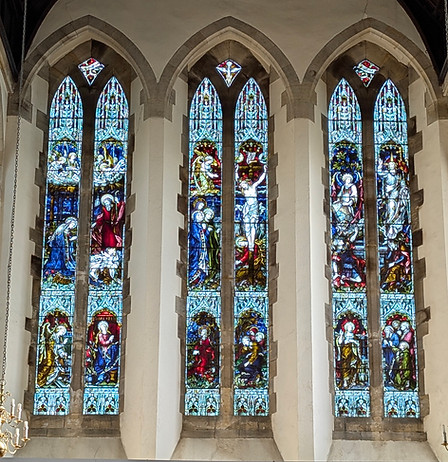
The East window at the front of the church portrays the birth, crucifixion and resurrection of our Lord and was erected in 1905 in memory of a long-serving sidesman, Mr David Beavers.
The reredos behind the main altar is the most impressive of the other memorials in the Church. The widow of Sir William Duncan, churchwarden 1897-1908, dedicated it in 1911. It is an interesting and extravagant piece of Edwardian sculpture designed by F. L. Pearson, son of the architect, and portrays our risen Lord triumphantly proclaiming the glorious truth of the resurrection.
The figures in the top row are all of angels. From left to right, they are: -
-
The Angel of Passion, with cross;
-
Raphael, the Angel of Guidance, with staff, water bottle and wallet;
-
Michael, the Angel of Justice, with sword and scales:
-
Gabriel, the Angel of Purity, with lily
-
Uriel, the Angel of Light
-
The Angel of the Resurrection
There are also two angels in the centres of the side panels.
The bottom figures are representations of the Patron Saints of the United Kingdom, of the Diocese of Ripon and Leeds and of this church. From left to right, they are: -
-
St. George of England (in battle array)
-
St. Wilfrid (with bishop's mitre, crook and robes)
-
St. Andrew of Scotland (holding a model of the cross saltire on which he died)
-
St. Patrick of Ireland (with conquered serpents)
-
St. Margaret of Antioch (crowned, Bible in hand and slain dragon at her feet)
-
St. David of Wales (with emblematic dove on his shoulder)

The Curate's pew (on the side opposite the organ) bears a poignant carved memorial to a brave young man. Richard Inge, a former curate, gave his life whilst serving in the R.A.F. in 1941 as he tried to save his co-pilot when the aircraft in which they were training crashed in flames. Richard was the son of the Very Rev. Dean Inge, Dean of St. Paul's Cathedral, well known for his writings between the wars and dubbed "The Gloomy Dean".
In the Choir Vestry (through the arch behind the choir stalls and the studded door just beyond it), the window is of great interest. It was installed here after being in storage for forty years, having originally been the East window of the old Bell Chapel and depicts the birth, death and ascension of Christ.
The Vicar's Vestry, with its cupboards and wardrobes, offers a fitting place for signing the registers at weddings. The church's most modern stained glass was inserted in the window here in 1955 by the children of J. F. Spencer, churchwarden 1896-1911, and portrays Jesus as the good shepherd. The Lady Chapel was furnished by the parents of Lt. C. F. Whitaker, who was killed in action during the First World War. Mr F. L. Pearson designed the reredos here, too, with an icon-like painting of the Adoration of the Magi. The two windows in the Lady Chapel are worthy of close study, as each has a great wealth of symbolic detail. The one on the right is based on the Te Deum and is dedicated to the memory of the Rev. T. F. Buckton, Vicar of the parish from 1893-1908 and later Archdeacon of Gibraltar.
The one on the left represents the Magnificat and was given by the Venerable Maurice Clarke, a former chorister at St. Margaret's and later Archdeacon of Madras. The windows in the North Aisle were both brought from the Bell Chapel when the church was built. The right-hand one, in memory of Elizabeth Shearer, who died in 1880, represents Jesus commissioning St. Peter. The other shows The Virgin Mary with the Holy Child and St. Joseph, in memory of George Shearer, Elizabeth's father-in-law, who died in 1833.
The small window above the cupboards in the West wall was given in 1898 by Mr. and Mrs. Tineson as a thank offering for the recovery of Mrs. Tineson from a serious illness: it is a picture of the raising of Jairus's daughter. Smaller items of note around the church include the portable wooden font, the altar frontal chest (in the Vicar's Vestry) and the 'Mousey Thompson' chairs and tables presented by the Froebelian School in 1965 (Look in the children's corner).

These and others all combine to enrich the church and to assist the congregation in their worship of Almighty God, to whose glory this church was built. It is well worth pausing to read the oldest memorial in the Church. It is the large tablet fixed to the West wall in memory of several members of the Stanhope family between 1708 and 1793, which was originally in the Bell Chapel. Alterations have been made to the church at various times. Some of the original pews at the back of the church were removed and the area is now carpeted, making it more convenient for socialising and serving coffee etc., after some services.
The South porch was altered to accommodate toilets. Installing an amplifying system proved helpful both to members of the congregation who were hard of hearing and also to preachers and readers with soft voices. The latest change is actually outside the main building, through the North door. The low-energy Parish Centre provides independent meeting rooms, kitchen and toilets. It was designed to match the original stone of the church.This smoke-darkened building can be seen for many miles around and is very dear to the hearts, not only of the congregation, but also of hundreds of other people in this area. The relatively recent floodlighting scheme provides the town with a night-time view of its greatest landmark; it won an award for its designers, too.
We hope that all our visitors will find peace and interest in this holy place.